
But what if true beauty didn’t lie in perfection, but in its opposite?
Welcome to the world of Wabi-Sabi. At LargeWallart, we believe that the most profound art doesn't just fill a space; it invites a feeling of serenity, history, and authenticity. Today, we delve into why this ancient Japanese philosophy is the most important trend in modern interior design.
What is Wabi-Sabi? A Brief History of the Imperfect
Originating in 15th-century Japan, Wabi-Sabi began as a reaction to the lavish, over-decorated trends of the time. It shifted the focus back to simplicity, nature, and the beauty found in the cycle of growth and decay.
-
Wabi represents rural simplicity, quietness, and inner richness.
-
Sabi refers to the beauty or serenity that comes with age and the passage of time.
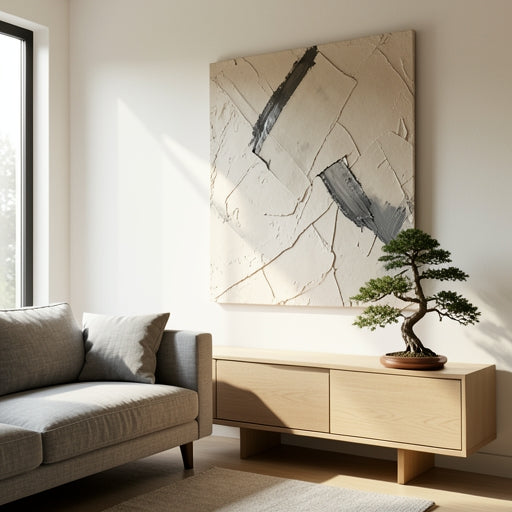
Together, they form a worldview that celebrates the "imperfect, impermanent, and incomplete." In the context of textured wall art, this means embracing visible brushstrokes, raw edges, and the organic variations of hand-applied plaster.
The 3 Pillars of Wabi-Sabi Art: Nothing Lasts, Nothing is Finished, Nothing is Perfect
To truly appreciate a piece of zen home decor, one must understand the three pillars of this aesthetic:
-
Nothing Lasts: Art should feel like it belongs to the earth. Earthy tones—beige, gray, and sand—evoke a sense of natural transience.
-
Nothing is Finished: A great painting leaves room for the viewer’s imagination. It doesn’t feel like a closed book; it feels like an ongoing story.
-
Nothing is Perfect: The slight asymmetry of a hand-painted piece is exactly what gives it "life."

Why Textured Art is the Perfect Medium for Wabi-Sabi
Why is texture so vital to this style? Because texture is tactile evidence of the human hand. When you hang a large textured painting in your living room, you aren't just adding a color to the wall; you are adding a physical presence.
The way light hits the heavy impasto ridges of a piece from our creates ever-changing shadows throughout the day. It transforms your wall into a living, breathing experience that a flat print can never replicate.
How to Style Wabi-Sabi Art in a Modern Living Room
Incorporating Wabi-Sabi doesn't mean your home has to look rustic. In fact, it is the cornerstone of the Japandi trend—a blend of Japanese minimalism and Scandinavian functionality.
-
Pair with Natural Materials: Match your textured art with raw wood furniture, linen curtains, and stone surfaces.
-
Focus on Negative Space: Don't clutter the wall. Let a single be the "anchor" of the room, surrounded by clean, quiet space.
-
Control the Lighting: Use soft, ambient lighting to highlight the physical depth and ridges of the paint.
The Investment Value of Handmade Originality
At LargeWallart, every stroke tells a story. In an era of AI-generated images and factory-made prints, a 100% handmade original is a rare investment. Our master artists spend hours layering plaster and pigment to ensure that your piece is the only one of its kind in the world.
When you invest in a textured Wabi-Sabi painting